Hey All,
Just letting you know that I've rescheduled the banding that was supposed to happen today (Thurs, 6/23) at Chippewa Nature Center for tomorrow (Fri, 6/24).
Thursday, June 23, 2011

Wednesday, June 22, 2011
Chippewa Nature Center Station, June 2 and 17
We started our summer banding at Chippewa Nature Center on June 2nd. It was a bit of a slow morning but we managed to dodge the threatening rain. Due to the heavy rains in May the wet meadow was just that, and then some. So much so that one of our net-sites was under about two feet of water, which prevented us from installing it. Therefore, we were running one less net than normal. Also a deer ran through another net, destroying it which closed that down for the day. Now we were down to eight nets. Great way to start the year!
We caught a total of 13 individuals of eight species, of which six were new, five were recaptures and two were unbanded.
The Swainson's Thrush is getting to be less and less of a surprise out here. Especially early in the season (late spring migrants) or late in the season (early fall migrants). I feel pretty confident that somewhere nearby in the county there may be a breeding population. All you hotshot birders, keep your ears open for Swainson's Thrush song!
There were several recaptures. The Gray Catbird and the Rose-breasted Grosbeak were both at least six-year old males. The Common Yellowthroat was three years old and one of the chickadees was four years old.
Here't the tally:
Black-capped Chickadee 1 N, 2 R
Swainson's Thrush 1 N
Gray Catbird 2 N, 1 R
Common Yellowthroat 1 R, 1 U
Northern Cardinal 1 N
Rose-breasted Grosbeak 1 R
Song Sparrow 1 N
Red-winged Blackbird 1 U
June 17 was our next banding day at CNC. Things were still very wet so the meadow net was still not in operation, although we did get it set up. We also reinstalled a net we haven't run since the first year of banding here in '04. It is in the Phragmites along the pond in an effort to capture the ubiquitous but elusive blackbirds. So we did have ten total nets opened.
Our capture total was 23 individuals of eight species, of which 17 were new, four were recaps and two were unbanded. It was a nice diversity of species including a female Indigo Bunting, a common species here, but not one that we catch a lot of.
It was a particularly good day for Northern Cardinals and Rose-breasted Grosbeaks. Which means there were sore fingers all around! Two female Red-winged Blackbirds is probably as many of that species as we've netted in one day. I still don't know how the most numerous bird out here is one we catch so infrequently.
The recaptures included the same Common Yellowthroat we caught on the 2nd and a Gray Catbird banded earlier in the morning. Another catbird proved to be an at least five-year old bird.
Here's the catch:
Black-capped Chickadee 2 N, 1 R
Gray Catbird 1 N, 2 R, 1 U
Common Yellowthroat 1 N, 1 R
Song Sparrow 3 N
Northern Cardinal 5 N
Rose-breasted Grosbeak 2 N, 1 U
Indigo Bunting 1 N
Red-winged Blackbird 2 N
Banding at the Vestaburg Station: June 3, 6, 13 and 20
OK, I'm just going to try to get caught up all in one go. After returning from Ecuador at the end of May it was totally nuts getting ready for the summer field season. As usual, we are doing our normal breeding bird banding study as well as our Veery foraging studies. However, it has been difficult capturing Veery this summer and as of today we have only caught one banded male.
Here are the tallies for the banding days we've completed so far:
June 3 we opened the nets around the bog in an effort to capture as many Veery as possible to radio-tag. In the ten bog nets we had a total of 14 birds captured of eight different species. Of these eight were new birds, three were recaps, and three were unbanded (and none were Veery!).
Our two recaptures, a Black-capped Chickadee and a Gray Catbird, were originally banded in '10 and '09. Both were HY birds when they were caught. I guess they liked it so much here they stayed, in the case of the chickadee, and returned, in the case of the catbird.
Ruby-throated Hummingbird 3 U
Downy Woodpecker 1 N
Eastern Wood-pewee 1 N
Blue Jay 1 N
Black-capped Chickadee 1 R
American Robin 3 N
Gray Catbird 1 N, 2 R
Northern Waterthrush 1 N
June 6 we ran the eight forest nets and also used audio playback at selected bog nets to try and attract Veery. We had a total of 13 captures of seven species of which 10 were new, one was a recapture (our first Veery!) and two were unbanded. Unfortunately, while attempting to affix the transmitter to our Veery, Señor Butterfingers (that would be me) bobbled the bird and it escaped. I'm sure this really impressed my students. The Veery was originally banded in '07 as an AHY bird. So, this individual was at least five years old.
The Eastern Phoebes that nest on the porch are back and had three young that were old enough to band. So we took this opportunity to band them.

While Downy Woodpeckers are one of the most common woodpeckers they are still attractive little birds.

These two American Robins demonstrate the difference in body plumage of an ASY male and an SY male. The top image is of an After Second Year male, showing the very black head and strong rufous breast, sides and belly. The bottom image is of a Second Year male with a much duller head and weaker rufous underneath.


Ruby-throated Hummingbird 2 U
Downy Woodpecker 1 N
Eastern Phoebe 3 N
Black-capped Chickadee 2 N
Veery 1 R
Wood Thrush 1 N
American Robin 3 N
June 13 we ran the eleven field nets and also continued to audio-lure around the bog. We had a total of 22 individuals of 13 species of which 19 were new, three were recaptures, and none were unbanded. Once again we managed to recapture the same Veery we had trapped the previous week. And once again, just as I had attached the transmitter, the bird struggled and left me holding two of it tail feathers with the transmitter while it flitted off into the bog. Veery - 2, Bishop - 0.
The Nashville Warbler was welcome as they are an intermittent breeder in the bog. This Indigo Bunting was welcome, because any bird this pretty should always be appreciated! This is a second year male, notice the brown coverts on the upper wing and the brown secondaries and tertials among the flight feathers.

And here's a photo of the Northern Flicker we caught just 'cause they're so darned good lookin'! Arguably the handsomest woodpecker in North America.

The recaptures included a four year old Hairy Woodpecker, an at least two year old Wood Thrush and a one year old Chickadee. In this photo of the Hairy Woodpecker, you can see the retained primary coverts (the feathers covering the tops of the outer flight feathers). Looking carefully you can see that they appear dull brownish-black in contrast to the more jet black primary coverts to the left.
By themselves these wouldn't allow me to narrow down the age of this bird, but coupled with the fact that all of the primaries, secondaries and secondary coverts are fresh and black tells me that the bird is at least an after second year. However, because it was banded I can do that one better. And that, my friends, is why we band.
Hairy Woodpecker 1 R
Northern Flicker 1 N
Blue Jay 2 N
Black-capped Chickadee 1 N, 1 R
Tufted Titmouse 1 N
Veery 1 R
Wood Thrush 2 N, 1 R
American Robin 5 N
Gray Catbird 2 N
Nashville Warbler 1 N
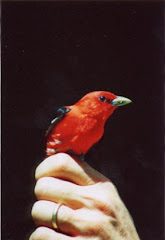
Scarlet Tanager 1 N
Rose-breasted Grosbeak 2 N
Indigo Bunting 1 N
June 20 we opened the bog nets as well as the forest nets, 18 nets in all. We caught a total of 17 individuals of 12 species, of which 16 were new and one was unbanded. By mid-morning we were continuing with our no-veery streak. So, in order for my students to have something to do we radio-tagged a Wood Thrush. Since we are trying out a new protocol in order to get more accurate locations of our birds, this will allow Emily and Morgan to identify and work out some of the snags and hopefully, before the breeding season ends we will have some Veery tagged.
The female Baltimore Oriole is the first one I've captured at the bog with a brood patch.

They nest here every year and every year we catch many of the young birds later in the summer after they've fledged. They show up in the bog in large numbers for the abundant blueberries and huckleberries. However, earlier in the season we don't catch many at all, primarily because they spend all of their time in the tree tops.
This Red-eyed Vireo nicely displays why it is so named.

Ruby-throated Hummingbird 1 U
Downy Woodpecker 1 N
Hairy Woodpecker 1 N
Acadian Flycatcher 1 N
Red-eyed Vireo 1 N
Black-capped Chickadee 2 N
Wood Thrush 2 N
American Robin 4 N
Common Yellowthroat 1 N
Ovenbird 1 N
Brown-headed Cowbird 1 N
Baltimore Oriole 1 N
Here are the tallies for the banding days we've completed so far:
June 3 we opened the nets around the bog in an effort to capture as many Veery as possible to radio-tag. In the ten bog nets we had a total of 14 birds captured of eight different species. Of these eight were new birds, three were recaps, and three were unbanded (and none were Veery!).
Our two recaptures, a Black-capped Chickadee and a Gray Catbird, were originally banded in '10 and '09. Both were HY birds when they were caught. I guess they liked it so much here they stayed, in the case of the chickadee, and returned, in the case of the catbird.
Ruby-throated Hummingbird 3 U
Downy Woodpecker 1 N
Eastern Wood-pewee 1 N
Blue Jay 1 N
Black-capped Chickadee 1 R
American Robin 3 N
Gray Catbird 1 N, 2 R
Northern Waterthrush 1 N
June 6 we ran the eight forest nets and also used audio playback at selected bog nets to try and attract Veery. We had a total of 13 captures of seven species of which 10 were new, one was a recapture (our first Veery!) and two were unbanded. Unfortunately, while attempting to affix the transmitter to our Veery, Señor Butterfingers (that would be me) bobbled the bird and it escaped. I'm sure this really impressed my students. The Veery was originally banded in '07 as an AHY bird. So, this individual was at least five years old.
The Eastern Phoebes that nest on the porch are back and had three young that were old enough to band. So we took this opportunity to band them.

While Downy Woodpeckers are one of the most common woodpeckers they are still attractive little birds.

These two American Robins demonstrate the difference in body plumage of an ASY male and an SY male. The top image is of an After Second Year male, showing the very black head and strong rufous breast, sides and belly. The bottom image is of a Second Year male with a much duller head and weaker rufous underneath.


Ruby-throated Hummingbird 2 U
Downy Woodpecker 1 N
Eastern Phoebe 3 N
Black-capped Chickadee 2 N
Veery 1 R
Wood Thrush 1 N
American Robin 3 N
June 13 we ran the eleven field nets and also continued to audio-lure around the bog. We had a total of 22 individuals of 13 species of which 19 were new, three were recaptures, and none were unbanded. Once again we managed to recapture the same Veery we had trapped the previous week. And once again, just as I had attached the transmitter, the bird struggled and left me holding two of it tail feathers with the transmitter while it flitted off into the bog. Veery - 2, Bishop - 0.
The Nashville Warbler was welcome as they are an intermittent breeder in the bog. This Indigo Bunting was welcome, because any bird this pretty should always be appreciated! This is a second year male, notice the brown coverts on the upper wing and the brown secondaries and tertials among the flight feathers.

And here's a photo of the Northern Flicker we caught just 'cause they're so darned good lookin'! Arguably the handsomest woodpecker in North America.

The recaptures included a four year old Hairy Woodpecker, an at least two year old Wood Thrush and a one year old Chickadee. In this photo of the Hairy Woodpecker, you can see the retained primary coverts (the feathers covering the tops of the outer flight feathers). Looking carefully you can see that they appear dull brownish-black in contrast to the more jet black primary coverts to the left.
 |
Hairy Woodpecker 1 R
Northern Flicker 1 N
Blue Jay 2 N
Black-capped Chickadee 1 N, 1 R
Tufted Titmouse 1 N
Veery 1 R
Wood Thrush 2 N, 1 R
American Robin 5 N
Gray Catbird 2 N
Nashville Warbler 1 N
Scarlet Tanager 1 N
Rose-breasted Grosbeak 2 N
Indigo Bunting 1 N
June 20 we opened the bog nets as well as the forest nets, 18 nets in all. We caught a total of 17 individuals of 12 species, of which 16 were new and one was unbanded. By mid-morning we were continuing with our no-veery streak. So, in order for my students to have something to do we radio-tagged a Wood Thrush. Since we are trying out a new protocol in order to get more accurate locations of our birds, this will allow Emily and Morgan to identify and work out some of the snags and hopefully, before the breeding season ends we will have some Veery tagged.
The female Baltimore Oriole is the first one I've captured at the bog with a brood patch.

They nest here every year and every year we catch many of the young birds later in the summer after they've fledged. They show up in the bog in large numbers for the abundant blueberries and huckleberries. However, earlier in the season we don't catch many at all, primarily because they spend all of their time in the tree tops.
This Red-eyed Vireo nicely displays why it is so named.

Ruby-throated Hummingbird 1 U
Downy Woodpecker 1 N
Hairy Woodpecker 1 N
Acadian Flycatcher 1 N
Red-eyed Vireo 1 N
Black-capped Chickadee 2 N
Wood Thrush 2 N
American Robin 4 N
Common Yellowthroat 1 N
Ovenbird 1 N
Brown-headed Cowbird 1 N
Baltimore Oriole 1 N
Sunday, October 10, 2010
Banding at the Vestaburg Station: 10/10/10
Wow, if I could only band once during October I guess I picked the right day! I was only open from 8 until 11 and I got a grand total of 48 birds of fifteen species of which 41 were new, four were recaps and two were unbanded. I pretty much got every late season migrant I've come to expect out there with the exception of red-breasted nuthatch, although I heard a few. I was a little surprised at the faint showing of white-throated sparrows given how noisy they were being. However, as it was, the number of birds that I got had me swamped.
So, we caught three red-bellied woodpeckers. That is only two shy of the total number of red-bellied woodpeckers I've ever caught at the bog. Not because they are uncommon, but because they tend to stay up high. One was a recapture that was originally banded 25 August of '08 as an HY bird. The two new individuals were HY birds born this summer. This is evident in these photos which show the bright ruby-red eye of the adult recapture (bottom) and the duller red-brown eye of the young bird (top).


So, we caught three red-bellied woodpeckers. That is only two shy of the total number of red-bellied woodpeckers I've ever caught at the bog. Not because they are uncommon, but because they tend to stay up high. One was a recapture that was originally banded 25 August of '08 as an HY bird. The two new individuals were HY birds born this summer. This is evident in these photos which show the bright ruby-red eye of the adult recapture (bottom) and the duller red-brown eye of the young bird (top).


It was a terrific day for golden-crowned kinglets. We had twelve for the day with eight of them in one net during the first round. Here are nice examples of a female (top) and a male (bottom).


Hermit thrushes made a good showing with 8 new birds and one escapee. Including this individual which nicely exhibited the buffy tips of the secondary coverts that are found on HY birds. This allows them to be aged in the fall of their birth year and the spring after.

This orange-crowned warbler, along with the yellow-rumped warbler we caught are regular late fall warblers. Like many of the rest of the October migrants they are not headed to the tropics but to the Tennessee valley south. While it is rarely visible through binoculars, here you can see the characteristic for which the orange-crowned is named.

Along with the white-throated sparrows that are moving through in big numbers right now (I hear them all over my neighborhood in the mornings) was one of my favorite sparrows. Partly because the fox sparrow is such a bruiser (it takes the same band size as a cardinal) and partly because it is so pretty.

And finally, as a portend of things to come, this dapper male dark-eyed junco let's us know that winter is not too far away.

Here's the tally:
Red-bellied Woodpecker 2 N, 1 R
Downy Woodpecker 1 R
Blue Jay 1 N
Black-capped Chickadee 4 N, 2 R
White-breasted Nuthatch 1 N
Brown Creeper 1 N
Ruby-crowned Kinglet 2 N
Golden-crowned Kinglet 12 N, 1 U
Hermit Thrush 8 N, 1 U
American Robin 2 N
Orange-crowned Warbler 2 N
Yellow-rumped Warbler 1 N
Fox Sparrow 2 N
White-throated Sparrow 3 N
Dark-eyed Junco 1 N
That will conclude things for the year. The rest of my October weekends are busy with other activities that prevent me from getting out again. This makes this the year with the lightest fall banding schedule on record. Hopefully 2011 will be less hectic. Stay tuned for updates from the winter American Kestrel study which will begin in January. And then before you know it, it will be spring again.
Hope to see you out there.
Tuesday, August 17, 2010
Banding at the CNC station 7/29 and 8/11
I'm playing catch-up posting banding results from the second to last and last summer banding days at Chippewa Nature Center. Neither day was particularly busy and both produced lots of HY birds as one would expect.
For 29 July we had a total of 19 captures of nine species of which 13 were new and six were recaps.
Here's the catch:
Black-capped Chickadee 1 N
House Wren 1 N
Wood Thrush 1 N
American Robin 2 N
Gray Catbird 5 N, 2 R
Ovenbird 1 R
Song Sparrow 1 N, 1 R
Northern Cardinal 2 R
American Goldfinch 2 N
For 11 August we had a total of 20 captures of nine species of which 17 were new, two were recaptrues and one was unbanded. This was our last banding day of the summer breeding study. It was what one might expect in early August. A lot of young birds and a few early migrants. Neither of the recaptures (a Common Yellowthroat and a Song Sparrow) were unusual, both being banded earlier this summer.
A Willow Flycather was a pleasant surprise as they occasionally nest here but we don't often catch them.

Willow Flycatchers were heard infrequently this summer and never enough to verify they were on territory much less mated. So, this is probably a wandering individual from another nearby location.
A molting adult male Blue-winged Warbler was the second for the summer, the first being caught way back on the 15th of May. The earlier bird was probably a returning migrant but probably not returning here as we didn't hear any Blue-wings singing this summer. This bird was probably also an individual from another location wandering around as it completed its molt before migrating south.

In this image you can see that the flight feather molt is completed as well as the body molt. So, he's all set for the journey south.
Finally, a definite migrant was this AHY female Canada Warbler.

They definitely do not nest locally and are coming from further up-state. We have often caught Canadas during our final banding session in August.
Here's the catch:
Downy Woodpecker 1 N
Willow Flycathcer 1 N
Black-capped Chickadee 6 N
Gray Catbird 2 N
Blue-winged Warbler 1 N
Common Yellowthroat 1 R
Canada Warbler 1 N
Song Sparrow 3 N, 1 R, 1 U
Northern Cardinal 1 N
Pay attention to announcements from Chippewa Nature Center about the fall migration banding weekend we will have Friday and Saturday September 17th and 18th. Hope to see you out there.
Tuesday, August 10, 2010
banding at the Vestaburg station
This year's summer banding went out with a whimper today. We opened all of the nets (29) and still only caught 18 individuals of 10 species of which 16 were new, one was a recapture and one was unbanded. Ovenbirds ruled the day of mostly one hit wonders. We captured a total of five ovenbirds and they were all HY birds that had already completed or were finishing up their pre-formative molt. So, they all looked nice and fresh like this individual.

We had an early migrant Swainson's Thrush that was enjoying the fruit selection in the old field. It was in the process of going through its pre-basic molt in preparation for its journey south.


We also still have babies coming off of the nest as evidenced by this juvenile Veery. It is just beginning its pre-formative molt that will shed its spotty juvenal plumage for more adult-looking outerwear.

A Northern Waterthrush was a nice surprise as our own breeding individuals down in the bog seemed to be on break this summer. Earlier in the season we only ever heard one singing male and only caught one individual at that time. No more turned up in the nets throughout the summer. This was a HY bird but it is hard to say whether it was born here or wandered in from elsewhere.

Finally, this Gray Catbird, while common showed incriminating evidence as to its lunch. It was also captured in the field feasting on the assortment of berries found there and the tell-tale stains on its face (and adorning our carrying bags) are proof.

Here's the tally:
Black-capped Chickadee 1 R
Winter Wren 1 N
House Wren 2 N 1 U
Veery 1 N
Swainson's Thrush 1 N
Wood Thrush 3 N
Gray Catbird 1 N
Black-and-white Warbler 1 N
Ovenbird 5 N
Northern Waterthrush 1 N

We had an early migrant Swainson's Thrush that was enjoying the fruit selection in the old field. It was in the process of going through its pre-basic molt in preparation for its journey south.

A female second year Black-and-white Warbler was a nice addition to our list. While we are within the breeding range for this species they don't nest at the bog. So, this female undoubtedly finished her breeding somewhere else, probably nearby, and is completing her molt before migration.

Another probable migrant was this Winter Wren. Winter Wren have nested at the bog and nest locally. However, we had no evidence of a pair nesting here this summer. We never had a male singing nor did we catch any individuals earlier in the season. So this HY individual more than likely wandered into our station during its pre-migration dispersal.


A Northern Waterthrush was a nice surprise as our own breeding individuals down in the bog seemed to be on break this summer. Earlier in the season we only ever heard one singing male and only caught one individual at that time. No more turned up in the nets throughout the summer. This was a HY bird but it is hard to say whether it was born here or wandered in from elsewhere.

Finally, this Gray Catbird, while common showed incriminating evidence as to its lunch. It was also captured in the field feasting on the assortment of berries found there and the tell-tale stains on its face (and adorning our carrying bags) are proof.

Here's the tally:
Black-capped Chickadee 1 R
Winter Wren 1 N
House Wren 2 N 1 U
Veery 1 N
Swainson's Thrush 1 N
Wood Thrush 3 N
Gray Catbird 1 N
Black-and-white Warbler 1 N
Ovenbird 5 N
Northern Waterthrush 1 N
Friday, July 30, 2010
Banding at Vestaburg Station, ACBO
Wow, it don't get much slower than this! We had a total of six birds of five species of which four were new and two were recaptures. All of the new birds were young of the year (HY) and the two recaptures were both originally banded last year.
This time of the summer both the young and adult birds are experiencing various stages of molt and the young birds are wearing unusual juvenal plumages. Consequently they often look pretty ragged. This morning's birds were no exception. Let's see if you can identify some of them. Answers at the bottom of the page.


The coolest thing we saw wasn't a bird but an insect. We noticed a metamorphosing cicada had climbed onto our banding table while we were working. So we transferred it to a nearby hawthorn tree and watched as it slowly emerged from its exoskeleton as a new adult cicada. This is the Annual Cicada, not the periodic species. These emerge every summer after having spent one to three years (depending on the species) underground.


You can see how its wings unfurl as it pumps blood into them. Over the rest of the day its exoskeleton will harden and darken until it is durable enough to fly into the trees and begin its monotonous afternoon serenading we listen to this time of year.
Here's the catch::
Wood Thrush 1 N
Gray Catbird 1 N
Ovenbird 1 N, 1 R
Field Sparrow 1 R
Northern Cardinal 1 N
Our next banding date for the Vestaburg station will be the week of August 9. I will send out an announcement closer to the time.
Bird #1 - Ovenbird
Bird #2 - Northern Cardinal
Bird #3 - Gray Catbird
Subscribe to:
Posts (Atom)