Here's one of the young Downy Woodpeckers caught today:

Here's the tally:
Downy Woodpecker 6 N
Black-capped Chickadee 2 N
Tufted Titmouse 2 N
House Wren 1 N, 1 U
Wood Thrush 1 N, 1 U
Gray Catbird 7 N, 2 R
Yellow Warbler 2 N
Common Yellowthroat 1 N, 1 U
Song Sparrow 5 N, 2 R
On 21 July it was a bit slower due to the intense heat and humidity we've been having and the fact that I closed the nets a bit early because of that. We caught a total of 17 individuals of six species and all were new birds. The Song Sparrows continued to make an impressive showing with seven individuals of which six came out of the same net! Most were young of the year as were several of the Common Yellowthroats and the Gray Catbirds. The Willow Flycatcher was a treat, since there has been a male on territory by one of our nets for the past three years but we have yet to capture it. So, we broke that streak. This was the first day in a long time with no recaptures.
This Gray Catbird demonstrates a phenomenon called fault barring.

This occurs during the growth phase of feather formation. If, as the barbs that make up the webbing of the feather (the part that extends from the feather shaft or quill), are being produced don't receive enough nutrients then the quality and number of barbs being made is reduced. Consequently, a weak spot appears across the feather at that point where the barbs are thinner and paler. If all of the feathers are growing in at the same time (which is the case with all young birds as they grow their first feathers before leaving the nest) then the bars line up from one feather to the next producing a pale line across the tail or wing.
Since this bird is a second-year bird (born last summer, '10) it still has the tail it left the nest with. So, we can surmise that during its growth in the nest it went through a pretty rough stretch in which it wasn't getting much if any food and probably none of good quality. Faintly visible in the right wing below my thumb is a corresponding fault bar in the primaries, which was also evident in the left wing when checked. At the end of this summer it will molt these feathers and replace them one by one devoting more resources to each feather, resulting in better quality feathers, hopefully. If fault bars form at this time they won't line up as they did in the juvenile since the feathers don't grow in simultaneously.
Here's the catch:
Willow Flycatcher 1 N
Gray Catbird 4 N
Common Yellowthroat 3 N
Song Sparrow 7 N
Northern Cardinal 1 N
Rose-breasted Grosbeak 1 N
At ACES in Vestaburg we've had two banding days at both the old field and the forest sites since my last posting. On 8 July, we had our biggest day of the year, so far. There were 28 captures of 11 species of which 16 were new birds, eight were recaptures and four were unbanded. We finally started catching Veery and were able to get radio tags on four birds. Although it was late in the season we have still been able to follow a couple around and collect locations for each. Robins dominated the captures with seven individuals coming to the nets and all were adults, which is a bit unexpected this time of year. Our first Brown Creeper of the year showed up as well. One of the veeries we recaptured was originally banded as an after hatching year bird in 2007 making it at least five years old.
Here are the totals:
Ruby-throated Hummingbird 1 U
Downy Woodpecker 1 N, 2 U
Tufted Titmouse 2 N
Brown Creeper 1 N
Veery 2 N, 3 R
Wood Thrush 1 R
American Robin 4 N, 2 R, 1 U
Gray Catbird 3 N, 2 R
Common Yellowthroat 1 N
Ovenbird 1 N
Northern Cardinal 1 N
Our next banding day was 12 July. We captured a total of 11 individuals of seven species of which 5 were new birds, four were a recaps and no unbanded birds. No big surprises but we did get to band the young of the Eastern Phoebe's second clutch on the front porch. None of the recaps were more recent than last year.
Here's the tally:
Downy Woodpecker 1 N, 1 R
Eastern Phoebe 3 L
Bluejay 2 N
Black-capped Chickadee 1 N, 1 R
American Robin 1 R
Common Yellowthroat 1 R
Song Sparrow 1 N
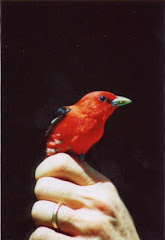
On 19 July we had a reasonably busy day and picked up a few infrequently captured species. Our total captures were 14 of nine species of which 21 were new, one was a recapture and one was unbanded. The exciting birds were the hatching year Northern Waterthrush, which breeds here but were in very low numbers this year, the Red-bellied Woodpecker and the Scarlet Tanager. We had another good showing of Downy Woodpeckers also. I think it is going to be a good year for that species.
Here is the male Scarlet Tanager we captured showing it changing from its striking breeding plumage to its more sedate greenish-yellow winter plumage.

Here's the catch:
Red-bellied Woodpecker 1 N
Downy Woodpecker 4 N
Black-capped Chickadee 1 N
Veery 1 N
Wood Thrush 1 N, 1 U
Gray Catbird 1 N, 1 R
Ovenbird 1 N
Northern Waterthrush 1 N
Scarlet Tanager 1 N
Finally, yesterday, 22 July, we caught a total of 15 birds of 11 species of which 12 were new and three were recaps, and no unbanded birds. No big surprises but like the 19th, a few infrequently captured birds. These included the Ruby-throated Hummingbird, Northern Flicker, and the Acadian Flycatcher. The recaptured Gray Catbird was originally banded as an after second year bird in 2008, making it at least five years old. With the exception of the hummingbird and the flycatcher, all of the rest of of the species had at least one hatching year individual among the captures. Lots of successful nests!
Here's the catch:
Ruby-throated Hummingbird 1 U
Northern Flicker 1 N
Acadian Flycatcher 1 N
Bluejay 1 N
Black-capped Chickadee 1 N
Wood Thrush 3 N, 2 R
American Robin 1 N
Gray Catbird 2 N, 1 R
Common Yellowthroat 1 N
Rose-breasted Grosbeak 1 N


No comments:
Post a Comment