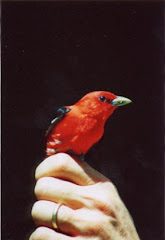
The Alma College Bird Observatory is operated by Mike Bishop of the Alma College Biology Department. The ACBO operates from April through October banding breeding birds and transient migrants as well as conducting directed studies of various breeding and overwintering species. The Vestaburg Station is located in Vestaburg, MI about 16 miles west of Alma. It is situated at the Alma College Ecological Station. The station is 186 acres of mixed hardwood forest, old fields, willow marshes and a relic boreal bog and lake. The Chippewa Nature Center Station is located at Dragonfly Marsh on the property of the Chippewa Nature Center near Midland, MI. It is approximately 96 acres and is a mixture of old fields, young forest and a large mitigated wetland.


Friday, July 30, 2010

Banding at Vestaburg Station, ACBO


Wow, it don't get much slower than this!  We had a total of six birds of five species of which four were new and two were recaptures.  All of the new birds were young of the year (HY) and the two recaptures were both originally banded last year.

This time of the summer both the young and adult birds are experiencing various stages of molt and the young birds are wearing unusual juvenal plumages.  Consequently they often look pretty ragged.  This morning's birds were no exception.  Let's see if you can identify some of them.  Answers at the bottom of the page.


The coolest thing we saw wasn't a bird but an insect.  We noticed a metamorphosing cicada had climbed onto our banding table while we were working.  So we transferred it to a nearby hawthorn tree and watched as it slowly emerged from its exoskeleton as a new adult cicada.  This is the Annual Cicada, not the periodic species.  These emerge every summer after having spent one to three years (depending on the species) underground.


You can see how its wings unfurl as it pumps blood into them.  Over the rest of the day its exoskeleton will harden and darken until it is durable enough to fly into the trees and begin its monotonous afternoon serenading we listen to this time of year.

Here's the catch::

Wood Thrush  1 N
Gray Catbird  1 N
Ovenbird  1 N,  1 R
Field Sparrow  1 R
Northern Cardinal  1 N

Our next banding date for the Vestaburg station will be the week of August 9.  I will send out an announcement closer to the time.

Bird #1 - Ovenbird
Bird #2 - Northern  Cardinal
Bird #3 - Gray Catbird

Monday, July 26, 2010

Banding at Vestaburg Station, ACBO

Today we ran most of the nets around the bog and five of the forest nets and caught more air than birds.  We had a total of 12 individuals of 11 species of which seven were new, two were recaptures and three were unbanded.  It was simply a slow morning, but not without some surprises.
'
Of our two recaptured birds, the cardinal was originally banded in July of '08 as a hatching year bird.  So, it has remained here to set up a territory and breed.


The Ovenbird was originally captured in July of '05 as an AHY bird.  So it was born in '04 or eariler.  That makes it a six year old bird or older.  It has been recaptured in '06 and again in '09.  And always in the same basic location.  He really likes his territory in the bog!  We also caught its close relative, a Northern Waterthrush.  Side by side you can see a lot of similarities between the two.


The Scarlet Tanager was a female that had clearly bred locally.  Her brood patch was in its later stages but not she was not yet molting her body feathers.


The Blue Jay was a bird born this summer, as was this Wood Thrush caught with its dad.  The juvenile bird is on the left and the adult is on the right.  Notice the spotty plumage characteristic of most baby thrushes.


Finally, we had the earliest recorded Magnolia Warbler for the station.  The earliest capture date for this species was previously 25 August.  We're a full month ahead of that date.  This was a female in full molt.  She had bred as her brood patch was still discernable as it was being refeathered.  So, the question is, how close was her breeding ground.  Unfortunately, we'll never no as she left us before we could band her or get pictures!

Here's the catch:

Ruby-throated Hummingbird  1 U
Blue Jay  1 N
Black-capped Chickadee  1 U
Veery  1 N
Wood Thrush  2 N
American Robin  1 N
Magnolia Warbler  1 U
Ovenbird  1 R
Northern Waterthrush  1 N
Scarlet Tanager  1 N
Northern Cardinal  1 R

Tomorrow (Tuesday, 27, July) we will be banding in the old field at the Vestaburg Station.
Hope to see you out there.

Wednesday, July 21, 2010

Banding at Chippewa Nature Center Station, Tuesday, 20, July


Today was surprisingly slow given the time of year and the weather.  It was slightly overcast at dawn with no wind and the station sounded birdy with lots of singing and movement all around.  However, they weren’t moving into the nets.  We had 13 total individuals of nine species of which ten were new, two were recaptures and one was unbanded.

We were surprised by a very early migrant Swainson’s Thrush (an AHY male).  We’ve only caught two of these during the summer in previous years, one on 28 May (a late spring migrant) and one on 6 August.  At my station in Vestaburg (Alma College Ecological Station) I’ve caught a total of six summer Swainson’s Thrush.  The earliest was 19, July.  Most of the rest were in early August.  Swainson’s Thrush nest as near as the next county north (Gladwin) so it isn’t unusual that we would see the occasional early migrant.


We had our second ruby-throated hummingbird of the summer, another breeding female.  Here we have one of my assistants helping me with her release.


Molt is the name of the game this time of year and most of the adult birds we caught were exhibiting fairly extensive body and flight feather molt.  This Ovenbird is pretty representative of the disheveled state many of our songbirds are in right now.


Finally, these two Common Grackles, while common, are also remarkably striking birds up close.  Especially the male’s iridescence.


Here is the catch:
Ruby-throated Hummingbird  1 U
Black-capped Chickadee  1 N
Swainson’s Thrush  1 N
American Robin  1 N
Gray Catbird  3 N
Ovenbird  1 N
Song Sparrow  2 R
Common Grackle  2 N
American Goldfinch  1 N

Our next day at CNC will be next Thursday (7/29).

Hope to see you out there.

Banding at Chippewa Nature Center Station, Friday, 16, July


Today was a make-up day for getting rained out yesterday (Thursday, 7/15).  And it more than made up for the inconvenience. We had 39 total individuals of 10 species of which 32 were new, six were recaptures and one was unbanded.

Four cedar waxwings were a nice catch.  It was two pairs and they showed the large variation in the wax tipped secondaries for which they get their name.  The first pair had no waxy tips at all and the second pair had a full complement.  Either way they are very attractive birds.


An American redstart was a bit of a surprise.  We don’t catch many at this site although they are a common nester locally.  This birds was a Second Year (SY) female and appeared to have been reproductively active.  How nearby it nested is anyone’s guess.  She was well into her pre-basic molt and really looks a mess!


The bird of the day was an American Woodcock.  This woodland shorebird is one of the oddest looking birds around.  Their camouflaged markings are exquisite and their eyes are set so far back on their head that have binocular vision both to the front and the back.  This was an HY bird and was probably fledged here at the station.  We had been flushing a woodcock earlier in the summer by the first net and there was probably a nest nearby.


Here's the catch:

American Woodcock  1 N
Ruby-throated Hummingbird  1 U
Black-capped Chickadee  3 N
American Robin  2 N
Gray Catbird  16 N,  3 R
Cedar Waxwing  4 N
American Redstart  1 N
Song Sparrow  3 N.  2 R
Brown-headed Cowbird  1 N
American Goldfinch  1 N,  1 R

Banding at Vestaburg Station, Tuesday, 13 July


I have to start by apologizing for not having an photos for today's blog.  I forgot my camera and I was kicking myself all morning.  Here's why: today set the summer banding record for the highest total number of birds caught and number of different species.  We had 64 total individuals of 19 species of which 57 were new, five were recaptures and two were unbanded.  That's five more new birds banded and two more species than the previous high day on 27, July, 2005.

It was a day of juvenile birds just off the nest, one hit wonders and families that stayed together by being banded together.  Of the downy woodpeckers, hairy woodpecker, northern flicker, eastern phoebe, black-capped chickadees, brown creeper, brown thrasher, northern cardinal, rose-breasted grosbeak, and Baltimore orioles, all captures were HY birds.  Of the five new wood thrush four were HYs.  Of the 12(!) American robins, nine were HYs.

We had a family of scarlet tanagers in the same net on successive rounds.  First we caught mom and dad and next round we caught their two kids.  They, along with many others, including the Baltimore orioles were in the bog foraging on the abundant blueberry crop.

It was just one of those perfect storms that sent us a boat load of birds.  We actually ran out of clean bags towards the end of the morning!

Here’s the tally:

Ruby-throated Hummingbird  1 U
Hairy Woodpecker  1 N
Downy Woodpecker  5 N
Northern Flicker  1 N
Eastern Phoebe  1 N
Blue Jay  1 N
Black-capped Chickadee  9 N
Brown Creeper  1 N
Wood Thrush  6 N,  4 R,  1 U
American Robin  12 N
Gray Catbird  6 N
Brown Thrasher  1 N
Cedar Waxwing  1 N
Ovenbird  3 N
Scarlet Tanager  4 N
Northern Cardinal  1 N,  1 R
Rose-breasted Grosbeak  1 N
Indigo Bunting  1 N
Baltimore Oriole  3 N

Our next banding date at the ACBO Vestaburg Station will be Monday 7/26 or Tuesday 7/27.  I will email the list to confirm later this weekend.

Hope to see you out there.

Banding at Chippewa Nature Center Station, Saturday, 3, July

Today we had a pre-4th of July celebration by opening the nets at our Chippewa Nature Center station.  We had 17 total individuals of nine species of which 14 were new and three were unbanded.

We were excited to get not one but three great crested flycatchers.  A very common bird here but not one we catch very often as they forage in the treetops and don’t come to the ground much.


This hatching year (HY) downy woodpecker shows the red “cap” that both sexes have before they go through their juvenal molt.  This is a female as the red is not in the location it would be found on a male, in the spot behind the white line over the eye.


Common Yellowthroats may be common but they sure are pretty.


Here’s the catch:

Downy Woodpecker  1 N
Great Crested Flycatcher  3 N
House Wren  1 U
Wood Thrush  1 N
American Robin  1 U
Gray Catbird  3 N,  1 U
Common Yellowthroat  1 U
Song Sparrow  3 N
Northern Cardinal  1 N