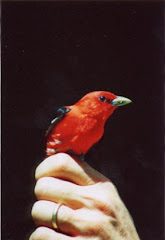
I had the opportunity to band an adult female Red-tailed Hawk today. Not one I caught but one that is being released back into the wild after having been flown by a falconer for a couple of seasons. I was contacted by Dave Frederick of Owosso, MI about banding his bird before he released it. He was curious to see if the bird would hang around or return to his home after being let go. I was unaware that falconers released their birds after a season of hunting, so I was interested in seeing if the bird would leave permanently or not as well.
So, we met halfway between our respective towns and I banded the bird. You can see the band in the photo below has a tab at the back. Unlike the bands we use for songbirds that just butt together, hawks and other birds of prey can pry those type off. So, we use an aluminum band that has a tab that folds over on itself and locks the band in place. You can see she still had the jesses (the leather straps that falconer use to restrain their birds) on below the band. Dave removed these of course before releasing her and she is now flying free again.
The thing I found interesting about Dave's bird was how tawny she was underneath. I'm so used to Michigan Red-tails (and all eastern red-tails) being so creamy white on the breast and belly. This bird had such a nice warm tone to her underparts.
Hopefully, she will be able to segue easily back into a wild lifestyle. While it is too late for her to find a mate and nest this season, she should be able to next year. My hope (and his) is that Dave never sees her again. But if a Red-tail does show up around his house, now he has the ability to make a possible identification if it is wearing a band.
Friday, April 30, 2010
Thursday, April 29, 2010
OK, I'm waiting...
I was only able to keep the nets open for a few hours this morning. And, since the promised south winds didn't live up to my expectations we didn't have a big influx of new migrants as I had hoped. I did manage to hear a few new birds but none of them entered the nets. More on those later.
I had a total of four individuals of three species and they were all recaptures. The oldest of the lot (as far as when it was banded is concerned) was a male Northern Cardinal. He was originally banded in '05 as a hatching year (HY) bird. Today he was caught in a net adjacent to the net in which he was originally captured. So, he's spent his whole life, presumably, in a small section of the old field.
The next oldest was one of the two Tufted Titmice. She was originally banded in '07, also as a HY bird. Today she was showing a well developed brood patch that indicated that she is finishing laying and getting ready to brood. She also came out of a net very close to the net of her original capture. The other titmouse was a male originally banded last summer as an after hatching year (AHY) bird.
Finally, I got another Blue Jay. This one was banded last year as an after second year (ASY) bird and was showing a brood patch then just as she was today. Her's indicated that she has probably just begun to lay eggs.
Other species seen or heard but not captured included the Vesper's Sparrow that sang its heart out all morning for us. I also finally had some warblers appear; a Yellow-rumped, a Nashville, and a Blue-winged. Of those three the Blue-winged is the most likely to be a returning breeder. Yellow-rumps, for the most part, breed further north and Nashville's only breed in the bog. Migration is happening even if it is keeping us guessing.
I won't be banding at the station for the next couple of weeks as my field ornithology course starts on Sunday when we take to the road. However, I plan to upload posts from the locations where we will be banding during that time. So, watch for announcements of tallies and exploits from our travels.
Monday, April 26, 2010
More net repairs and where are the migrants?
While I'm really out there to do my spring cleaning (mostly clearing trails and net lanes and repairing nets) I also like to see what is coming through. So, I leave the nets open as I work and check them frequently. However, apparently I don't need to check them much at all because no one is volunteering. Today I captured a female Blue Jay and recaptured a female Tufted Titmouse. And that was it. I'm not hearing a whole lot of other birds other than the residents. I still haven't seen or heard a Yellow-rumped Warbler! My fellow banders around the state are echoing the same refrain.
If I'm only going to catch two birds I can't complain if one is a Blue Jay. Despite their reputations as bullies and feeder hogs no one can deny that they are pretty birds. And this picture seems to indicate she has the attitude to prove it.
While Tufted Titmice aren't the flashy birds that Blue Jays are they more than make up for it in spunk. This one never relaxed for its picture while trying to teach me a lesson for catching it again. It was originally banded last year in May.
While neither the male nor the female graced my nets today the pair of Eastern Phoebes that nest on the front porch lights are back this year and and the female has been sitting on eggs, effectively banishing me from the porch for the next few months.
I was interested in how many eggs she was brooding. So, when she flew off at one point I checked to see how many there were and noticed one felt larger than the others. My suspicions were confirmed when I snapped this picture of the interior of the nest. The speckled egg at the bottom of the picture belongs to a brown-headed cowbird. There was a broken cowbird egg on the floor beneath the nest that the female phoebe had discarded. Unfortunately, she somehow missed this one.
I am not at liberty to comment on the fate of the cowbird egg in the nest.
One of my favorite plants is up and growing in the bog. The sundew is a plant that is especially adapted to live in the acidic environment of a sphagnum bog. Due to the very low levels of nitrogen because of the acidic pH some plants have evolved strategies to overcome this limitation. They capture insects and eat them! The leaves of the sundew have hair-like projections that are tipped with a sticky sap that attracts and captures insects. Then as the insects decompose the plant absorbs the nitrogen rich proteins the insects are made up of.
If I'm only going to catch two birds I can't complain if one is a Blue Jay. Despite their reputations as bullies and feeder hogs no one can deny that they are pretty birds. And this picture seems to indicate she has the attitude to prove it.
One of my favorite plants is up and growing in the bog. The sundew is a plant that is especially adapted to live in the acidic environment of a sphagnum bog. Due to the very low levels of nitrogen because of the acidic pH some plants have evolved strategies to overcome this limitation. They capture insects and eat them! The leaves of the sundew have hair-like projections that are tipped with a sticky sap that attracts and captures insects. Then as the insects decompose the plant absorbs the nitrogen rich proteins the insects are made up of.
Notable birds seen but not captured (just about anything) included Belted Kingfisher, Winter Wren, White-throated Sparrow, and a Wild Turkey that almost sent me into cardiac arrest when it flew out from its ground roost a mere ten or so feet from me.
My next banding day will be Thursday (4/29) weather permitting. Hope to see you out there.
Thursday, April 22, 2010
Net Repairs and a couple of birds
Today I spent most of the morning repairing nets damaged by deer last season. I did leave them open while I was laboring and managed to catch a few birds, although I heard and saw many more than I caught.
This male Ruby-crowned Kinglet was the first volunteer. He was still showing a fair amount of fat so is probably headed a ways north before he gets to his breeding grounds.
I also caught four Black-capped Chickadees of which two were banded and two were new. Both of the recaptured birds were originally banded last summer. One was an adult last year and one was a hatching year bird last summer.
And that was it. Notable birds seen but not captured were Sharp-shinned Hawk, Ruffed Grouse, Blue-gray Gnatcatcher and Vesper's Sparrow. I suspect this next week will see things pick up regarding neo-tropical migrants.
To round an otherwise slow day out, here are some of the trees that are in blossom at the station:
Amelanchier
Apple (just about to pop)
Pin Cherry
Here's the tally:
Ruby-crowned Kinglet 1 N
Black-capped Chickadee 2 N, 2 R
I should be running nets again on Monday (4/26).
Tuesday, April 20, 2010
Tuesday, 20 April, 2010
I spent the day setting up the nets around the bog and only had them open for a few hours around noon. Not the birdiest time of the day and the two Black-capped Chickadees I caught were testament to that. However, one of them was a recapture and was originally banded in September of 2006 as an HY bird (born that summer). So, she is a four year old bird which is quite respectable for anything that small that withstands Michigan winters year after year.
Sorry, no pictures. The "brand new" batteries in my camera were not so brand new, apparently. I'll be out again on Thursday. Hopefully, it will be a bit busier.
Subscribe to:
Posts (Atom)